
It’s 3 AM, and you’re back in the nursery—again. Between the dreaded Moro reflex, the constant kicks that leave them exposed, and the ‘contact nap’ loop where your baby only sleeps if they’re glued to you, the sleep deprivation is real. We all know that quality sleep is the cornerstone of your baby’s development, but for parents, it’s about survival.
That’s where the sleep sack comes in—the ultimate nursery MVP. But with the market flooded with everything from ‘Star-shaped’ transitional sacks to classic ‘Tube’ bags, finding the right fit feels like solving a puzzle with no instructions.
Stop the midnight guesswork. In this guide, I’m breaking down the anatomy of baby sleep sacks to help you identify exactly what your baby needs to graduate from restless nights to dream-filled slumber. Let’s reclaim your sleep.
Why Your Baby’s "Rolling Milestone" Changes Everything
Before we talk shapes, we have to talk safety. Once your baby shows signs of rolling over, the AAP (American Academy of Pediatrics) dictates that traditional swaddles—where the arms are pinned down—must be retired.
This creates a “Transition Gap.” Your baby still has the startle reflex that wakes them up, but they now need the mobility to roll safely. This is where the debate between Star Sacks and Tube Sleep Bags begins.
The "Star-Shaped" Sack: The Transitional Hero
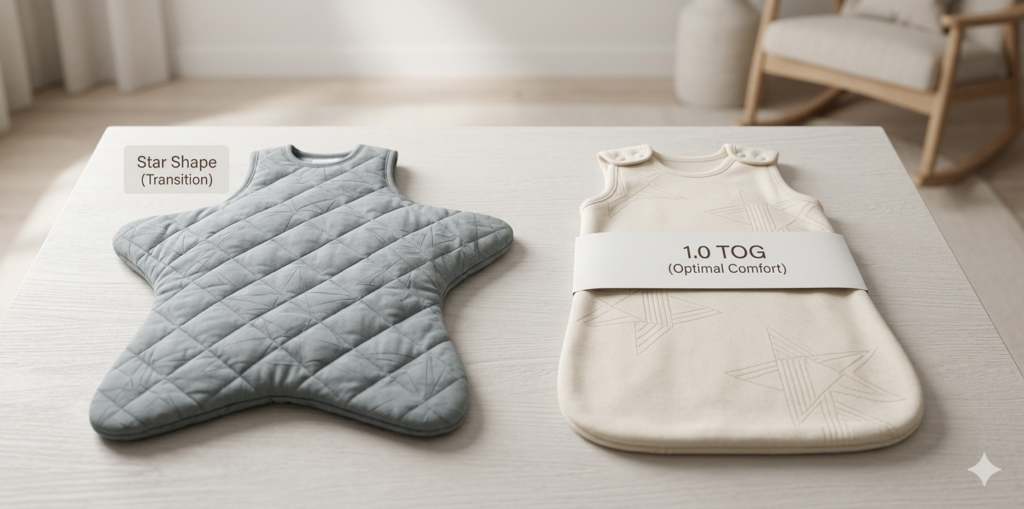
The Star-shaped sack (often seen in designs like the Zipadee-Zip) features enclosed sleeves and a star-like silhouette.
- Who is it for? Babies aged 2–6 months who are showing early signs of rolling but still struggle with the Moro reflex.
- The Pro: It provides just enough resistance to calm the startle reflex, without physically pinning the arms down. It’s the perfect bridge.
- The Con: Short lifespan. Once your baby is an active crawler or toddler, the star wings can feel restrictive or bulky. Think of this as a temporary “nursery bridge,” not a permanent destination.
” While some call them sleep sacks, others refer to them as baby sleeping bags or wearable blankets. Regardless of the name, these act as your baby’s ‘safe sleep uniform.’ When choosing the right baby sleeping bag, focus on the TOG rating and the arm mobility… “
The "Tube-Shaped" Sleep Bag: The Long-Hauler
This is the standard sleep bag—an open-arm, bell-shaped sack that allows for full range of motion.
- Who is it for? Babies 6 months and older who have mastered rolling and need total freedom of movement.
- The Pro: Longevity. A high-quality tube bag can often fit from 6 months up to 3 years. It promotes self-soothing because the baby can access their hands, and it supports healthy hip development due to the roomy bottom.
- The Con: If you introduce this too early to a baby with a fierce startle reflex, they may wake themselves up because they have too much room to move.
Star Sack vs. Traditional Baby Sleeping Bag Comparison
| Feature | Star-Shaped Sack | Tube-Shaped Sleep Bag |
| Best Age | 2–6 Months | 6 Months – 3 Years |
| Startle Suppression | High | Low |
| Mobility | Limited / Transitional | Full Freedom |
| Lifespan | Short (3-4 months) | Long (1–2 years) |
| Self-Soothing | Partial | Excellent |
Expert Decision Framework: What Does Your Baby Need Right Now?
Still confused? Use this simple roadmap:
- Is your baby hitting themselves awake? If yes, and they aren’t rolling yet, the Star Sack is your best bet to get through the night without a traditional swaddle.
- Is your baby a “rolling machine”? If yes, move straight to the Tube Sleep Bag. You need to prioritize hip safety and movement freedom.
- Are you looking for a “one-and-done” investment? If you want to buy once, invest in a premium 4-season Tube Bag (like [Woolino] or [Kyte Baby]). While you might have a rough week of transition, it pays off in long-term sleep success.
Safety & Pro-Tips for Your Switch
- The Fit Test: Regardless of the shape, ensure the neck hole is snug. If the sleep sack can be pulled up over your baby’s nose, it is too big. Safety always comes first.
- Minimalist Crib: The sleep sack is the only thing that should be in the crib. Avoid loose blankets or pillows, no matter how cute they look in nursery photos.
The Final Verdict
Sleep sacks are a journey, not a static purchase. You might start with a transitional Star Sack to survive the 4-month sleep regression, and eventually graduate to a high-quality Tube Bag for long-term comfort.Sleep sacks are a journey, not a static purchase. You might start with a transitional Star Sack to survive the 4-month sleep regression, and eventually graduate to a high-quality Tube Bag for long-term comfort.
Ready to make the switch?
[Shop my top recommended Tube Bags on Amazon] for long-term sleep.
Not sure about the sizing? Read my [Kyte Sizing Guide] to make sure you get the perfect fit for your little one.
Sleep tight—you’re doing a great job, Mama.